Showing posts with label exhibitions. Show all posts

18 June 2012

Map sampler: Festival of Britain 1951 (I)


In 1951, the Festival of Britain was staged.  To quote Wikipedia: " The Festival of Britain was a national exhibition in Britain in the summer of 1951. It was organised by the government to give Britons a feeling of recovery in the aftermath of war and to promote the British contribution to science, technology, industrial design, architecture and the arts." (source, also for the progam below).

And if you look at all the prewar patriotic embroideries, it's hardly suprising that there was an embroider sampler design relating to the Festival of Britain.  The first three pictures here show one example.  The colours are I think a trifle faded, perhaps through exposure to light.


Below are pictures of a second example.  Much brighter colours.  As the festival celebrated aspects of British life and culture, so do the images on the sampler.  From the top down: a deer/stag, and a bagpipe-playing Scotsman; a lute or harp; coming in from Ireland, an aeroplane; a ?dancer on a stage, and what looks like a circus tent; a Welsh lady playing a harp, the bust of William Shakespeare, a Beefeater and kettle drums with a music book; a roundabout/merry-go-round; a ?Cornishman with ?a squeezebox/small accordion; a sailor on a boat or barge; and a mermaid (or else a topless lady drowning and waving her knickers in the air to get the sailor's attention, which seems both unlikely and indecorous).  Also, of course, flags and around the Festival of Britain logo on the top right, the floral emblems of the British Isles; and bunting, echoing the design on the program pictured below.

And, you will notice, colour and lots of it.  More and more I think the Kent and Leicester county map samplers are likely pre-war.

This one seems very likely to have been a transfer design too.  How things have changed - few designs from the first fifty years were counted cross stitch, most were embroidery and based on samplers.  Most British patriotic designs now are counted work based on charts, whether cross stitch or tapestry/needlepoint.  Are we somehow more afraid of embroidery (the early designs didn't boast many complex stitches)? Were transfers, cheap to post, the easy way to transport designs then, while now counted charts can be downloaded from the internet or printed in magazines with no need to fiddle with stamps and envelopes?  Is there a preference now, for the exactitude of counted work, and perhaps a flavour of 'getting it right' or 'making exactly the same thing, because I like that sample' ?  I wonder.  I don't know.

A few more images of the second example:


Here is an image of a Festival program, to show you that stylised Britannia-head logo:


I wonder too about the form of this sampler being a map.  It's not just about showing the country, but also I think showing the country which resisted and prevailed in the very recent war, the country that was not invaded, close though they might have come.  Maps, after all, are essential to war and a matter for secrecy during war.  I've tagged this blog entry with wartime even though it's six years after, as the shadow of World War II is undoubtedly present in the reason for the Festival.  Rationing, for example, did not finally end until 1954.

I've seen several other versions of this design, so it must have been quite popular.  Which argues that it must have been in a wide-circulation newspaper or magazine, seen by many, chosen by a number of embroiderers to make in celebration.  It could have been a transfer, but a couple of examples I've been able to look at more closely seem to be on remarkably similar fine evenweave fabric, so I'm more likely to believe it was sold as a transfer already ironed onto fabric.

But I don't know.  If you do, please leave a comment with any useful information or links.

In light of the many coronation embroidery designs from 1937, and the many more coronation designs from 1953, only two years after the Festival of Britain, I find it interesting that at the moment, this is the only Festival of Britain design I've come across.  Was it a category-killer, catching the imagination? Were there few or no competitor designs?

Whatever the story (I wish I knew more), this is a particularly delightful British patriotic sampler, in my opinion.

24 September 2011

Defiant POW cross stitch from World War II

Making is the most powerful way that we solve problems, express ideas and shape our world. What and how we make defines who we are, and communicates who we want to be. *

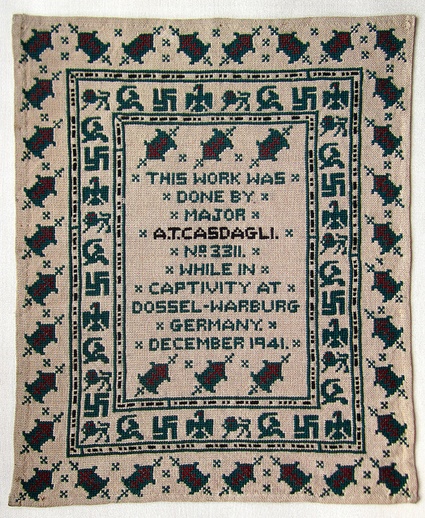
From this blog entry at Mr X Stitch, I learned about the upcoming Power of Making exhibition at the Victoria & Albert Museum.  Among the objects displayed is this:


After six months held by the Nazis in a prisoner of war camp, Major Alexis Casdagli was handed a piece of canvas by a fellow inmate. Pinching red and blue thread from a disintegrating pullover belonging to an elderly Cretan general, Casdagli passed the long hours in captivity by painstakingly creating a sampler in cross-stitch. Around decorative swastikas and a banal inscription saying he completed his work in December 1941, the British officer stitched a border of irregular dots and dashes. Over the next four years his work was displayed at the four camps in Germany where he was imprisoned, and his Nazi captors never once deciphered the messages threaded in Morse code: "God Save the King" and "Fuck Hitler".

The Mr X Stitch blog entry has a link to a longer article in the Guardian, Nazis, needlework and my Dad by Patrick Barkham, from which the above quote is taken.  The Guardian article has this photo of Major Alexis Casdagli's son, holding one of his father's cross-stitch pieces that illustrates his father's WWII POW cell:


...and here is what the article says about this piece:

In a bleak, claustrophobic part-map and part-diagram, his father created a needlework of "Room 13, Spangenberg castle". The stitching depicted inmates' cells, a few lumps of coal, a sign saying "bath every 14 days", and a menu: "soup, potatoes, wurst, bread, semolina". At the bottom was a Union flag. National flags were forbidden in the camp, so Casdagli sewed a canvas flap over it with "do not open" written on it in German. "Each week the same officer would open the flap and say, 'This is illegal,' and Pa said, 'You're showing it, I'm not showing it.'"

Here is the information from the end of the Guardian article:

Power of Making is at the V&A from Tuesday until 2 January 2012, www.vam.ac.uk. A Stitch in Time: God Save the King – Fu*k Hitler! by Captain A Casdagli, available from lulu.com. Tony Casdagli is participating in a free workshop at the V&A. Crafting the Collection: Power of Making, 17 September, 11am-4pm.

About the Power of Making exhibition:

The V&A and Crafts Council celebrate the role of making in our lives by presenting an eclectic selection of over 100 exquisitely crafted objects, ranging from a life-size crochet bear to a ceramic eye patch, a fine metal flute to dry stone walling. Power of Making is a cabinet of curiosities showing works by both amateurs and leading makers from around the world to present a snapshot of making in our time.
The exhibition showcases works made using a diverse range of skills and explores how materials can be used in imaginative and spectacular ways, whether for medical innovation, entertainment, social networking or artistic endeavour.
Making is the most powerful way that we solve problems, express ideas and shape our world. What and how we make defines who we are, and communicates who we want to be.
For many people, making is critical for survival. For others, it is a chosen vocation: a way of thinking, inventing and innovating. And for some it is simply a delight to be able to shape a material and say ‘I made that’. The power of making is that it fulfills each of these human needs and desires.
Those whose craft and ingenuity reach the very highest levels can create amazing things. But making is something everyone can do. The knowledge of how to make – both everyday objects and highly-skilled creations – is one of humanity’s most precious resources.

The Guardian has a slideshow of some of the other works in this exhibition:

Not quite the same work as the more usual royal/patriotic fare I find for this blog, but just as important to document and include as British patriotic needlework.  Glad to have found it to share.  And I like the discussion/explanation of the importance of making.


19 September 2011

Elizabeth II: Diamond Jubilee (I)

With the Queen's Diamond Jubilee in 2012, designers and crafters and others are already gearing up with ideas.  Here's a roundup of some designs, news, exhibitions and ideas I've found recently.  I'm sure there will be more to document as the jubilee draws closer, which is why this blog entry is labelled as Diamond Jubilee (I).  You can also navigate to entries of interest by using the tags on each entry.

From Katiemae Designs you can obtain the chart for this blackwork embroidery:

Read more and order the chart here:
http://katiemaedesigns.info/Samplers.html
It costs  £5 (check on the site re postage costs to your location).

This is the same designer who made a detailed blackwork chart of Westminster Abbey for the royal wedding of William and Kate (as shown in my blog entry about W&K royal wedding samplers). 
See it and buy the chart here: http://katiemaedesigns.info/Buildings_and_Landmarks.html

***

Embroidery teacher Jacqui McDonald, who teaches at the Royal School of Needlework, blogs that she is working on a Diamond Jubilee design involving stumpwork, blackwork and goldwork.  No image of the design as yet. 
Read the blog entry here:
http://www.hand-embroidered.co.uk/blog/read_34020/jubilee-celebrations.html
Read about the three classes in January 2012 which will teach the design:
http://www.hand-embroidered.co.uk/events_71565.html
Later in 2012 there will be a class showing how to mount your embroidery in a Jubilee Casket.
[Is is just me, or does 'casket' just have too much funereal association???  what with the Queen not being precisely young and all, even if her mother did live to be over 100 years old...]

***


Glimpses of Blighty is a competition being run by Madeira Threads and ICHF in the UK.   Here is their description:

‘Blighty’ is a slang term for Britain, first used in the latter days of the British Raj. It is now more commonly used as a term of endearment by the expat British community or those on holiday to refer to home.
With the world’s eyes focused on Great Britain, firstly with the Royal Wedding last April, and with the Olympics and the Queen’s Diamond Jubilee next year – let your imagination run wild and embroider all that is ‘Best of British’ both past and present, and you could WIN one of our fabulous prizes! There’s a prize for each Category winner and a superb prize for the overall winner!

It will be interesting to see what works might come from this.

Read more here:

***
Jacksons of Hebden Bridge, who sell kits for church kneelers, have several designs in kneelers and cushions telated to the diamond jubilee:


Kneeler above, tent-stitch cushion below.


Kneeler above, cross-stitch cushion below.


The final one, shown below, disappoints me a tad.  The energy and verve of the diamond jubilee logo have, to my mind, lost a lot of their charm by being 'regularised' into straighter geometry.  Not necessary, to me.  Here's the original logo, followed by Jacksons of Hebden Bridge's kneeler and cros-stitch cushion designs.


The company sells kits of their designs.  Visit their selection of jubilee designs here:
http://churchkneelers.com/jubilee_shop.php
Prices range from £35.95 to  £59.95 for a cushion kit,  £42.25 to  £52.95 for a kneeler kit.  Check on the site for postage costs to your location.

***

A background briefing document from the Royal School of Needlework advises:

The RSN has an extensive collection and archive and to enable more people to see
some of its holdings, it offers themed tours. For 2012, in celebration of Her Majesty
The Queen’s Diamond Jubilee the RSN’s theme will be Royal RSN
 
Read the document here:
http://www.royal-needlework.org.uk/images/uploaded/Documents/Events/rsn%2Bbackgound%2Binformation%2B29.04.pdf

Keep an eye on the site for more information on jubilee exhibitions/events.  The RSN may well produce a jubilee sampler design for sale - they did a whitework one for the recent royal wedding (see the royal wedding samplers blog entry I wrote in April 2011 for more info). 

***

This crown stencil from Stencil Library has embroidery/stitching potential, possibly with cotton thread/gold thread/beading/as a wool-stitched tapestry...


They suggest it could be stencilled over a Union Jack design too.


Pricing: The size of the crown is 21cms high by 20cms wide (that is roughly 8 inches) but you can have it made to other sizes. Just ask. The price of the new crown at 21cms high is £18.50. UK postage is free. Add £3 postage for EU countries and £5 for everywhere else in the world.  Packages are sent by Royal Mail.

Read more on the Design Inspiration blog here:
http://designinspiration.typepad.com/design_inspiration_planet/2011/04/an-exclusive-crown-stencil.html

In another blog entry, they show how to use a stencil to create a tapestry design on canvas:
http://designinspiration.typepad.com/design_inspiration_planet/2009/06/stencils-and-tapestry.html

Link for Union Jack stencil:
http://www.stencil-library.com/docs/exclusives05.html

***
Trend BIble sees "British Street Party" as a coming trend, influenced by the diamond jubilee and the London Olympics. 


See all their images here:
http://www.trendbible.co.uk/blog/news/news-top-drawer-autumn-trend-feature/

Question for self: what sorts of samplers/embroideries will be around for the London Olympics, and do they fall within or outside my collection development/blog scope policy??...)

***

Finally...

Not directly related to embroidery/samplers, but of interest if you are in the UK and able to visit is the touring exhibition The Queen: Art and Image.


This is a description of it:

To mark the Queen’s Diamond Jubilee in 2012, the National Portrait Gallery is staging an innovative touring exhibition bringing together sixty of the most remarkable and resonant images of Elizabeth II. This will be the first National Portrait Gallery exhibition to tour to British venues before being shown in London, opening in Edinburgh in June, Belfast in October and Cardiff and London in 2012.

The exhibition includes formal painted portraits, official photographs, press images and works by contemporary artists and explores the evolution of the way The Queen has been portrayed during the sixty years of her reign.  Artists and photographers include Pietro Annigoni, Cecil Beaton, Lord Lichfield, Andy Warhol, Lucian Freud and Gerhard Richter and their works are accompanied by archival material – from film footage to postage stamps.

The Queen: Art and Image celebrates and explores the startling range of artistic creativity and media-derived imagery that the Queen has inspired. It also probes the relation of this imagery to a world of changing values during a reign that has engaged the attention of millions.Read more here:
http://www.npg.org.uk/whatson/exhibitions/2012/the-queen-art-and-image.php
Catalogue book (harcover or paperback) is available - details here:
http://www.npg.org.uk/shop/shop-list.php?showProductDetails=4819
Or if you want postcard books, badges and more:
http://www.npg.org.uk/shop/shop-list.php?cat=royalty&inx=1

***

Please leave a comment to advise of any other useful related links, patterns, designs or kits related to the diamond jubilee. 


Related Posts Plugin for WordPress, Blogger...