Showing posts with label military. Show all posts

14 September 2012

Post-war sampler, 1947 : Freedom, Justice, Peace


An embroidered postwar patriotic sampler, dated 1947, with guardsmen and symbols of Britain including cottage, castle and church and the Union Jack, celebrating the victories of 1945 and the war's end.


The frame measures 10 1/2inches by 12 1/2inches, so this image gives you a sense of the design size.  I would guess this design to be based on a transfer.

If you know any more about this design, please do leave a comment.


28 May 2012

Edward VIII : abdication sampler (II)


This is the second version I've seen of this particular sampler: I blogged about the first one here.  Or this may be the same sampler, reauctioned, as both have AMP 1936 on them, likely the initials of the maker.  Design area is 14inches x 18inches.

This one is very particularly about Edward and the abdication: it might seem almost disloyal to be celebrating the king who left the throne rather than focusing on the king who took on the job, but in the public view (with the press barons censoring/editing coverage of Edward VIII's wilder/less wise moments) he was an heroic figure, and his abdication a loss.

Sylvia over at Linens and Royals bought this one - read her blog entry here.  She says it's a Royal School of Needlework design, original price 7/6.

I still like the sense of the modern age in this sampler - industry, sport etc as well as traditional Union Jacks and guardsmen.  And the ?prescient inclusion of the three military figures representing army, navy and air force, with WW2 only two years in the future.

If you know any more about this design, please do leave a comment so it can be shared with others.


21 April 2012

Wartime embroidery from World War II: four images

This embroidery was for sale last year.  It seems likely to date from the 1940s.  Would someone have stitched it much after the war had ended? But in wartime, would someone have had the thread and fabric to make this? Was it featured in a magazine or newspaper, and how would this have been affected by paper shortages?  It could have been based on a transfer, but that's guesswork only.

Anyway, it's a fascinating stitched insight to a particular time.


I can only make out three of the four tag lines:
where the Navy reigns, guard the streets, ?? and plough the land.  Under REMEMBER there might be a date on the blue banner.  The tag line I can't make out looks to be something related to the services, judging by the badges - Army, Navy, RAF?


If you know any more about this design, please leave information and link/s in the comments.


03 December 2011

Peace Sampler: 1945


Earlier this year on eBay this peace sampler was offered.  It is patriotic rather than royal, commemorating the end of World War II for Britain - VE Day and VJ Day, both in 1945.  The design features a lot of symmetry - the flags and searchlights; and balances different motifs representing the Allies in a pleasing way - the Eiffel Tower and the Statue of Liberty, the kangaroo facing the elephant.  I particularly like the font on this.  I do not know if it was a commercially-available design/transfer or the work of a single embroiderer (if the latter, she certainly had design ability as well as stitching skill).  As the seller noted, if it was made when or soon after the war ended, materials to make it would likely have been in short supply.  I find the searchlights particularly poignant as a reminder of the constant danger of wartime life for civilians as well as those in the services.

A couple of pictures showing it in more detail:


There are quite a few samplers commemorating the jubilees and coronations of the 1930s and 1950s, many if not most from commercial interests and sewn by many many embroiderers and needlewomen.  I have seen fewer designs relating to World War II.  Partly, no doubt, because the nation was busy elsewhere - pattern designers and newspaper columns and magazines (paper shortages, too).  But there is a history of wartime needlework.  In quilting, the famous quilt by Jane Stickle known through Brenda Papadakis' Dear Jane book has, in the bottom corner of her immensely complex design (dozens and dozens of 4in blocks, all different), the evocative embroidered phrase, "In War-Time, 1863" - the US Civil War.  During World War II, the women interned (in terrible conditions) by the Japanese at Changi made three quilts - including one for their Japanese captors - from embroidered signature squares.  Read more about the Changi quilts here and here.  Possibly the most poignant square is this one:


There are so many records of war - in words and images and stitches.  These ones in stitches I find to have a particular and immediate impact.  The hands that stitched them were there with the needle and thread, and the stitched words and images feel as individual and close as fingerprints, humans connecting over time.

I think that's why I find these British patriotic samplers and embroideries so compelling and interesting and engaging, that sense of a connection to another individual life.  I wonder if, for some of these, the embroidered sampler is the only thing that survives of some of these people.  Clothes and possessions can be dispersed, household chattels dispensed with: but the samplers have the testament of an individual's  life, and a specific time in that individual's life when they committed themselves to the task of commemorating an event of importance to them.  There's a sadness in that so few of these have a record (either stitched on the sampler or noted on the back of the frame etc) of the embroiderer's name.  So they survive as testament to mind and heart, but to the mind and heart of someone anonymous.  I have asked for provenance for some of those I've added to my collection, but nearly always they've come from a fair or clearance sale, not from a known household or person. 

There's a curious quality to all these patriotic samplers, most particularly the royal ones - few if any of the embroiderers would ever have been likely to meet the monarchs whose jubilees and coronations they laboured for many hours and days to stitch and remember; and yet clearly they felt involved and connected, that these things were important enough to them to spend that time and create the artefact of their patriotism.

And if you look at the earlier blog entry about William and Kate's wedding, the patriotic sampler industry is alive and well and finding customers in 2011, as samplers and embroideries associated with Charles and Diana events did in the 1980s and 1990s.

As ever, if you know any more about the design/source of the peace sampler illustrated above, please do leave a comment. 


24 September 2011

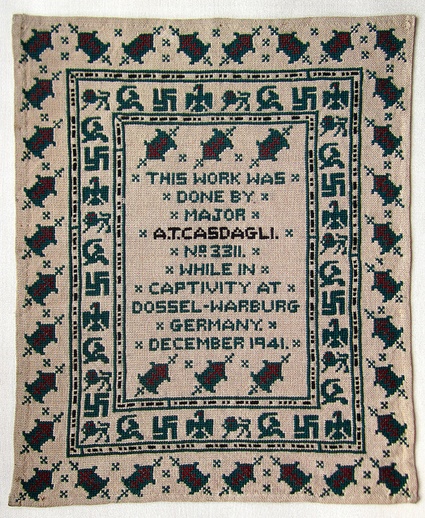
Defiant POW cross stitch from World War II

Making is the most powerful way that we solve problems, express ideas and shape our world. What and how we make defines who we are, and communicates who we want to be. *

From this blog entry at Mr X Stitch, I learned about the upcoming Power of Making exhibition at the Victoria & Albert Museum.  Among the objects displayed is this:


After six months held by the Nazis in a prisoner of war camp, Major Alexis Casdagli was handed a piece of canvas by a fellow inmate. Pinching red and blue thread from a disintegrating pullover belonging to an elderly Cretan general, Casdagli passed the long hours in captivity by painstakingly creating a sampler in cross-stitch. Around decorative swastikas and a banal inscription saying he completed his work in December 1941, the British officer stitched a border of irregular dots and dashes. Over the next four years his work was displayed at the four camps in Germany where he was imprisoned, and his Nazi captors never once deciphered the messages threaded in Morse code: "God Save the King" and "Fuck Hitler".

The Mr X Stitch blog entry has a link to a longer article in the Guardian, Nazis, needlework and my Dad by Patrick Barkham, from which the above quote is taken.  The Guardian article has this photo of Major Alexis Casdagli's son, holding one of his father's cross-stitch pieces that illustrates his father's WWII POW cell:


...and here is what the article says about this piece:

In a bleak, claustrophobic part-map and part-diagram, his father created a needlework of "Room 13, Spangenberg castle". The stitching depicted inmates' cells, a few lumps of coal, a sign saying "bath every 14 days", and a menu: "soup, potatoes, wurst, bread, semolina". At the bottom was a Union flag. National flags were forbidden in the camp, so Casdagli sewed a canvas flap over it with "do not open" written on it in German. "Each week the same officer would open the flap and say, 'This is illegal,' and Pa said, 'You're showing it, I'm not showing it.'"

Here is the information from the end of the Guardian article:

Power of Making is at the V&A from Tuesday until 2 January 2012, www.vam.ac.uk. A Stitch in Time: God Save the King – Fu*k Hitler! by Captain A Casdagli, available from lulu.com. Tony Casdagli is participating in a free workshop at the V&A. Crafting the Collection: Power of Making, 17 September, 11am-4pm.

About the Power of Making exhibition:

The V&A and Crafts Council celebrate the role of making in our lives by presenting an eclectic selection of over 100 exquisitely crafted objects, ranging from a life-size crochet bear to a ceramic eye patch, a fine metal flute to dry stone walling. Power of Making is a cabinet of curiosities showing works by both amateurs and leading makers from around the world to present a snapshot of making in our time.
The exhibition showcases works made using a diverse range of skills and explores how materials can be used in imaginative and spectacular ways, whether for medical innovation, entertainment, social networking or artistic endeavour.
Making is the most powerful way that we solve problems, express ideas and shape our world. What and how we make defines who we are, and communicates who we want to be.
For many people, making is critical for survival. For others, it is a chosen vocation: a way of thinking, inventing and innovating. And for some it is simply a delight to be able to shape a material and say ‘I made that’. The power of making is that it fulfills each of these human needs and desires.
Those whose craft and ingenuity reach the very highest levels can create amazing things. But making is something everyone can do. The knowledge of how to make – both everyday objects and highly-skilled creations – is one of humanity’s most precious resources.

The Guardian has a slideshow of some of the other works in this exhibition:

Not quite the same work as the more usual royal/patriotic fare I find for this blog, but just as important to document and include as British patriotic needlework.  Glad to have found it to share.  And I like the discussion/explanation of the importance of making.


21 August 2011

WWI Patriotic embroidery from the Australian War Memorial

This embroidery is in the collection of the Australian War Memorial in Canberra.  Here is the description:

Patriotic souvenir embroidery on blue cotton sateen, mainly in red, white, blue and black couched longstitch. The top of the embroidery bears the words 'UNITED WE STAND', and a king's crown. There are Allied flags down each side of the cloth. The centre, underneath the crown and within an embroidered laurel wreath, once bore a 'padded' cloth photograph frame in the shape of a life buoy and a portrait photograph. Both of these are now missing, although the marks made by them can be clearly seen. Underneath the missing frame is a painted picture of a naval engagement between British and German ships, possibly representing the Battle of Jutland in 1916. The picture is 'framed' by brown fabric made to look like brown rope.

Read more: http://cas.awm.gov.au/item/REL/06667


Related Posts Plugin for WordPress, Blogger...