15 January 2012

Elizabeth II: Greenwich Golden Jubilee embroidery

In the year of Queen Elizabeth's diamond jubilee, you might like to take a moment to view and learn more about the golden jubilee embroidery made in Greenwich.


Explore the image in greater detail here:
http://www.greenwichembroideries.org.uk/pagejubilee.html

Read about its genesis here:
http://www.greenwichembroideries.org.uk/pagejubileestory.html
and its contents here:
http://www.greenwichembroideries.org.uk/pagejubileecontent.html

Read about the embroiderers and who sewed which element/s here:
http://www.greenwichembroideries.org.uk/pagejubileeteam.html

09 January 2012

Elizabeth II : Diamond Jubilee : emblems and logos

A couple of Commonwealth countries have released Diamond Jubilee emblems/logos.  Very traditional in style, nothing like the charming originality of the official UK logo design.  Here's the UK one, in English and Welsh (read more about it and past logos here):


Here's the NZ emblem for the Queen's Diamond Jubilee in 2012, released at the end of November:


More information: click here.  From that link (the New Zealand Governor-General's site) comes this description:
"The emblem has been officially approved by Queen Elizabeth II.  Its diamond shape represents the 60 years of her reign.  Other features of the emblem include a gold koru, manuka flowers and the Royal Cypher, the Queen’s personal emblem.  The emblem was designed by Phillip O’Shea CNZM, LVO, New Zealand Herald of Arms."

And here is the Canadian choice for their emblem on this occasion:


More information - click here and here.  From the second source, some more about the design:

"The Diamond Jubilee emblem design was inspired by the 2002 Golden Jubilee emblem. It is a symbolic statement of the enduring relationship between Canada and The Crown, as personified by Her Majesty The Queen, Canada's Head of State. 
The Royal Cypher is The Queen's monogram below St. Edward's crown. It is used in the insignia of orders, decorations and medals, and on various badges. Beneath the Royal Cypher, a red maple leaf is positioned on one stem and disposed on a diamond. The numeral "60" denotes the Diamond Jubilee of Her Majesty's reign as Queen of Canada.
Rising up on either side in a wreath formation are a series of maple leaves in graduated tones-from crimson red to brilliant gold to forest green-representing our provinces and territories, as well as the seasonal beauty of Canada."

Wikipedia has a page about the Queen's Diamond Jubilee here.

I still like Katherine Dewar's UK design best.

08 January 2012

Elizabeth: golden jubilee roses sampler, 2002


This is a magazine chart, with the magazine buyer free to make it as a cross stitch or as a needlepoint/tapestry, depending on their preference.  It commemorates the Golden Jubilee of Elizabeth II.

I find it boring, myself.  OK, roses represent England, but these look more derivative of that Old Country Roses china that is insistently yellow and stridently red than the more subtle or Tudor-style roses found on other royal embroideries.  Still and all, that's apparently a hugely popular china pattern so maybe this design found its aficionadoes. I get that it's got the golden thing happening, but it doesn't do anything for me.  My second gripe is that it looks kinda pastiche - you could take out the words and it's just another cushion design. Compared to other jubilee designs from the 20th century - Georges V and VI, and earlier Elizabeth ones - this has a lot less royal symbolism or interest in the design, for me anyway.  Maybe you disagree.  That's your privilege.

There's a certain harmony, when you put a bunch of British patriotic/royal samplers together on a wall - design echoes, colour repetition.  This one wouldn't fit in at all, in my opinion.  Not that I mind something different (see the next picture): but I think this design lacks appeal.

2012 marks the Diamond Jubilee for Elizabeth II, so it will be interesting to see what sorts of commemorative designs are published in magazines and produced as kits this year.  I just LOVE the Diamond Jubilee logo:

Read more about it(and other QEII  jubilee logos) in an earlier blog entry here.
As you spot any Diamond Jubilee designs (online, in magazines, in kits etc) do leave a comment here so I can add them to the array.  Thanks!


02 January 2012

Elizabeth II: Diamond Jubilee (IV) : Happy and Glorious Riverdrift House sampler


I rather like this Happy and Glorious sampler for the Queen's diamond jubilee (probably because it's the kind of one you can do in bits - a crown here, a word there, some bunting... reminds me a bit of antique spot samplers). 

It's from Riverdrift House in Suffolk, designed by Amanda Stevenson. It is described thus: "Best quality materials include white 14 count Zweigart Aida fabric, Anchor 6-stranded embroidery threads, clear chart, instructions and a gold-plated needle.Size of finished embroidery approx 25 cm / 10 inches square."

As yet I haven't seen a stitched example: this looks to be based on a computer-generated chart.

This one isn't on their website when I last checked [see update below] - it turned up on eBay.  Maybe they're testing the market?  It's very much 'in style' with their other samplers.  They have some rather nice souvenir ones for various British towns eg. Felixstowe, Cumbria, Aldeburgh, Cotswolds and (unsurprisingly) Suffolk.  They use nice colours - some muted, some brighter -  and attractive modern/vintage fonts.  Here is their eBay user page: http://myworld.ebay.co.uk/riverdrifthouse/ which will link you to their current sale items.  As of today they are offering it in both a bidding scenario and a buy-it-now scenario.  They do post outside the UK (you can also buy direct from their website).

On their new design page they indicate their plans for other jubilee samplers: "Next on the board are the new designs for the DIAMOND JUBILEE, still to be finalised - but you can expect a set of FOUR square, each featuring one of the Royal Residences, lots of crowns and corgis - on 14 count. Then we will put the four together to make a more substantial Sampler to stitch on 18 count, for a lovely piece of heirloom stitching... "

None of which sounds like this one, as I can't see a royal residence... still, I think this is my favourite so far of the commercial cross stitch sampler designs for the diamond jubilee.  Maybe the category killer?

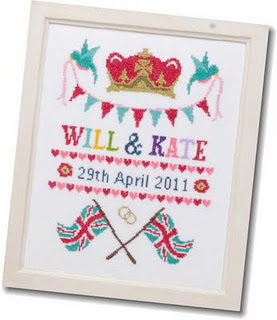
It has a feel of Jacqui Pearce's very popular Will and Kate wedding sampler that was in Cross Stitcher magazine.  Nodding to vintage and traditions, while being unashamedly modern.

Read all about that design, with links as to where you can buy it in my blog entry about 2011 wedding samplers.  They seem to be out of kits now, but seem to still have the sampler pattern available for download.  The magazine, Cross Stitcher issue 238 Spring 2011, turns up from time to time on eBay; so does the pattern as pages taken from the magazine.  You can also buy the full issue on Zinio as a digital download full colour copy to read on your computer or tablet/iPad (Zinio has a website at zinio.com or you can download the app to your tablet/iPad and buy from within the app.  That single issue is $AU5.49 for the digital download as of December 2011).

I'm documenting diamond jubilee designs as I find them.  If you know of others, please do let me know by leaving a comment.  All these entries are tagged with jubilee so you can find them via the tags as well as the search button (top left of the screen).

If you're a shop or designer with a design I haven't documented here as yet, please do get in touch.  I'd like this to be as comprehensive a record as possible.

Happy New (Diamond Jubilee) Year!

Ruth

3 January 2012 UPDATE:
The Riverdrift design is now listed on their website:
Diamond Jubilee Square Sampler Kit
Counted Cross Stitch Square Sampler Kit
Price:
£12.95

Riverdrift House New Designs information:
Riverdrift House News page:


01 January 2012

Anne: birth sampler, 1950


From 1950, and featuring a verse by Patience Strong, this sampler commemorates the birth of Princess Anne.


I've also seen verse by Patience Strong featured on a wedding sampler for Elizabeth and Phillip, and a birth sampler of similar design for Prince Charles.  I know that the Charles one was a transfer, so no doubt this one was too - embroiderer's choice of evenweave fabric and final thread colours, level of skill depending on the embroiderer.

Who was Patience Strong? According to Wikipedia, Winifred Emma May (4 June 1907 – 28 August 1990) was a poet from the United Kingdom, best known for her work under the pen name Patience Strong. Her poems were usually short, simple and imbued with sentimentality, the beauty of nature and inner strength.


Hmmm, 'imbued with sentimentality' is being rather polite, really.  She's got the rhyme thing happening...

Isn't it nice that Clarence House gets a run, instead of Windsor Castle or Buckingham Palace?!!

I've never seen a birth sampler for Andrew or Edward, in this style or any other.  Or wedding samplers for either, come to that.  Although I'm guessing that checking the popular British cross stitch magazines at those date would have been likely to have had some kind of charted design.  (Topic for future research - unless you have the mags and could look them up and tell me...). 

There is a picture of another version of this sampler here, from the end of this blog entry here.

And another version of this sampler:


And another:


If you know any more about this design - where it was published/available from etc and so forth - please do leave a comment.


25 December 2011

Elizabeth II: Christmas message 1952


In 1952, following the example of her father, George VI, the new Queen Elizabeth did her first Christmas broadcast, which included the words in the embroidery above.  This was an example from eBay this year.  As with other embroideries (as opposed to cross-stitch designs), the examples I've seen show the variations produced by embroiderers with different levels of skill and who have made individual variations to thread colour (I don't think it's always fading from sunlight - if you look at the letter E on the side in these examples, it's in a single colour in one, and more than one colour in another).  I suspect this must have been a transfer, as the examples I've seen are on different colours of evenweave linen/cotton, from light cream to deeper beige/brown.

You can read more about the Queen's 1952 Christmas broadcast on her website (click here).   That page has links to all her Christmas messages.

Here's another version of this sampler:


...and another...


...and another, that had a couple of detail photos too..


Christmas Greetings!  I plan to continue documenting British patriotic samplers in this blog into the future.  It fascinates me how many there are, and how many people have chosen to make them.  Particular thanks and greetings to Sylvia at Linens and Royals for her much appreciated comments and for being so inspiring with her amazing collection of British patriotic samplers.

If you know more about this design eg. where and how it was published, please do leave a comment.


18 December 2011

21st June, 1982

Does 21st June, 1982 ring any particular bells for you? (Bells were rung on the day, I have no doubt).

Another clue:


Somebody thought it important enough to design quite a detailed work.  Someone thought it significant enough to make this tapestry.

Have the crown and the date and the stylised English roses given it away? (extra clue: Charles and Diana were married in 1981... did you spot their initials at the top of the design?)

I think the red/white/blue item at the bottom of the design is intended to be a cradle.  There's a lot of fecund/flourishing greenery.

You must be close to guessing, or have already guessed, that this records the birth date of Prince William.

It's done in wool on tapestry canvas - as a tapestry or needlepoint, depending on your terminology.  The cream areas are unstitched, so you can see through them to the backing board.

If you know any more about this design - where/if it was published, who designed it, if it was available as a kit - please do leave a comment.  It could have been a charted design (thus able to be used for cross stitch or canvas tapestry stitching) or a kit.  I incline towards the charted design (maybe in a magazine) because most tapestry kits of this vintage and up to the present day generally include enough tapestry wool to stitch the background, whereas counted cross stitch on Aida cloth/linen/evenweave doesn't usually involve stitching the background.  This stitcher chose to interpret the chart using wool and tapestry canvas, rather than as counted cross stich.   There are earlier designs from the 1930s and 1950s employing tapestry canvas with the background left unfilled/holey, but it's rare for more recent work, in my opinion.


11 December 2011

Elizabeth II : Diamond Jubilee (III)


Found on The Making Spot blog:

"
Ten years ago Needlecraft magazine celebrated the 50th anniversary of HM Queen Elizabeth II's reign with this stitchy project.
Stitching is golden with this vintage pattern from the the 2002 Golden Jubilee.

For the best result, stitch the foreground first but don't carry dark colours from one area to another otherwise they could show through when you stitch the background.

“The long legged cross stitch gives a pretty plaited effect and gives an instant edging. It's the perfect finish for a project that's fit for a queen!”

PS. Why not adapt it for the 2012 HM Queen Elizabeth's II Diamond Jubilee in 2012!
"

I am amused by 2002 being 'vintage' already...

It's a simple combination of rose, leek, thistle and shamrock. The original has a tapestry/woolwork look to me, but a counted chart can of course be done in cross stitch or tapestry, as you prefer.

The pattern is a free download - go to the blog page here for the download link.

Hmmm.  I don't think I've yet seen the 'category-killer' Diamond Jubilee pattern yet....


10 December 2011

George VI: 1937 coronation chairback & 1953 Yeoman of the Guard tunic

I can understand that this Yeoman of the Guard tunic from the 1953 coronation of Elizabeth II was a 'professional' item, so to speak: worn by a participant on the day -


Nice embroidery on it, too (it was on eBay: can't imagine parking this in a corner of my parlour!).

But here's a chairback embroidery from George VI's 1937 coronation:


...which is like a window on a world now gone.  I can't imagine this was done for use on the day at the ceremony: my guess is that it was done to adorn an armchair in someone's parlour.  The embroidered side visible on the back of the chair, the plain side to prevent Brylcreem or hair oil or pomade or whatever were the hair unguents of the time from soiling the fabric on the chair.

Instead of a bouquet of flowers, it is a patriotic statement: the king and queen's initials, the floral emblems of England, Ireland, Scotland and Wales, with the crown over all and the coronation date.  Where many British patriotic samplers have fussy detail, this one is a simpler and strong graphic statement.

I've never seen an Edward VIII version of this (ER would be the intials, I presume, for Edward Rex).  I find the font particuarly evocative of its time, slightly olde-worlde-calligraphic in style.  It's not a small design, either - the design occupies an area of around 12 inches square.

I have seen a couple of versions of this, with slight colour variations which would imply that this was a transfer design which individual embroiderers interpreted in their own colour selections - either because they liked their choice better, or they used what thread colours they had easily to hand.

Here is another version that was found as an embroidery, not as the long rectangle of a chairback.  You can see the lighter fabric and changes in thread colour.


I wonder what else was in that patriotic parlour? And if this chairback (and any others, if the embroiderer made a pair) were used for display/special occasions, or at all?

If you know any more about this design - where it was published, who designed it, whether it was a transfer - please do leave a comment.

03 December 2011

Peace Sampler: 1945


Earlier this year on eBay this peace sampler was offered.  It is patriotic rather than royal, commemorating the end of World War II for Britain - VE Day and VJ Day, both in 1945.  The design features a lot of symmetry - the flags and searchlights; and balances different motifs representing the Allies in a pleasing way - the Eiffel Tower and the Statue of Liberty, the kangaroo facing the elephant.  I particularly like the font on this.  I do not know if it was a commercially-available design/transfer or the work of a single embroiderer (if the latter, she certainly had design ability as well as stitching skill).  As the seller noted, if it was made when or soon after the war ended, materials to make it would likely have been in short supply.  I find the searchlights particularly poignant as a reminder of the constant danger of wartime life for civilians as well as those in the services.

A couple of pictures showing it in more detail:


There are quite a few samplers commemorating the jubilees and coronations of the 1930s and 1950s, many if not most from commercial interests and sewn by many many embroiderers and needlewomen.  I have seen fewer designs relating to World War II.  Partly, no doubt, because the nation was busy elsewhere - pattern designers and newspaper columns and magazines (paper shortages, too).  But there is a history of wartime needlework.  In quilting, the famous quilt by Jane Stickle known through Brenda Papadakis' Dear Jane book has, in the bottom corner of her immensely complex design (dozens and dozens of 4in blocks, all different), the evocative embroidered phrase, "In War-Time, 1863" - the US Civil War.  During World War II, the women interned (in terrible conditions) by the Japanese at Changi made three quilts - including one for their Japanese captors - from embroidered signature squares.  Read more about the Changi quilts here and here.  Possibly the most poignant square is this one:


There are so many records of war - in words and images and stitches.  These ones in stitches I find to have a particular and immediate impact.  The hands that stitched them were there with the needle and thread, and the stitched words and images feel as individual and close as fingerprints, humans connecting over time.

I think that's why I find these British patriotic samplers and embroideries so compelling and interesting and engaging, that sense of a connection to another individual life.  I wonder if, for some of these, the embroidered sampler is the only thing that survives of some of these people.  Clothes and possessions can be dispersed, household chattels dispensed with: but the samplers have the testament of an individual's  life, and a specific time in that individual's life when they committed themselves to the task of commemorating an event of importance to them.  There's a sadness in that so few of these have a record (either stitched on the sampler or noted on the back of the frame etc) of the embroiderer's name.  So they survive as testament to mind and heart, but to the mind and heart of someone anonymous.  I have asked for provenance for some of those I've added to my collection, but nearly always they've come from a fair or clearance sale, not from a known household or person. 

There's a curious quality to all these patriotic samplers, most particularly the royal ones - few if any of the embroiderers would ever have been likely to meet the monarchs whose jubilees and coronations they laboured for many hours and days to stitch and remember; and yet clearly they felt involved and connected, that these things were important enough to them to spend that time and create the artefact of their patriotism.

And if you look at the earlier blog entry about William and Kate's wedding, the patriotic sampler industry is alive and well and finding customers in 2011, as samplers and embroideries associated with Charles and Diana events did in the 1980s and 1990s.

As ever, if you know any more about the design/source of the peace sampler illustrated above, please do leave a comment. 


27 November 2011

Houses of Parliament


On eBay this year there have been several embroideries featuring buildings with royal associations, including this Houses of Parliament one with Big Ben and, in the foreground, the Thames.  They have been done in this impressionistic style of embroidery, quite fine stitching/thread, sometimes with a single thread colour like this one, and sometimes with multiple colours.  I wonder if they were transfers?  It seems unlikely that they were done freehand, and I can't see how they could be charted (well, they're not cross-stitch).  I've seen a couple of other examples which I'll add to this blog in the future.

If you know any more, please do leave a comment.

25 November 2011

Elizabeth II: Diamond Jubilee (II)

More Diamond Jubilee designs I've found.

From One Off Needlework, a cross stitch design with a more unusual palette of blues and greens displaying the plant symbols of Britain.  You can find the kit (with Aida cloth) here for £27.96 and other places have it (eg. Majesty magazine).
The next design is being marketed on eBay UK and also through the designer's Etsy site.  There doesn't yet seem to be a stitched example: instead, the images look like computer generated ones showing a whiter background and more cream toned background.


The designer's Etsy site is NeverDyingPoet - click here.  The Etsy sales are in PDF form, emailed (?the modern version of the transfers sold for coronation samplers?).

If you find Diamond Jubilee samplers I haven't already featured here, please do leave a comment with a link to alert me.


20 November 2011

George VI: coronation sampler with cross-stitched background, 1937


Listed on eBay earlier this year was this George VI coronation sampler from 1937.  In comparison to some other designs - for example the George V jubilee sampler with coaches from an earlier blog entry here - this looks distinctly chunky.  It seems to be due to at least two elements: the design itself (not a lot of grace about that coach, it looks semi-motor-car-like) and the size in which it has been worked (it's on tapestry canvas rather than evenweave linen or cotton).  Interesting to note the military figures: there were rumblings in Europe at the time.  The 1953 coronation samplers were much more likely to have jolly Beefeaters than the soldier and sailor featured here.


The background is also interesting.  The brown is cross-stitches - the entire background has been filled in.  One of the advantages of cross-stitch or embroidery samplers is that generally you don't have to fill in the background (unlike pictorial cross-stitch such as some of the photo-style William and Catherine designs illustrated in an earlier entry on this blog; or unlikehand-stitched needlepoint/tapestry with continental or ten stitch where every square of the design on canvas is generally filled).  Perhaps the stitcher stitched the design, saw how the canvas looked and chose to cover it up.

If you know where this design was published, please do leave a comment.

13 November 2011

George VI: coronation tablecloth, 1937


From a past eBay auction, all four corners of the tablecloth featured this design.  It measured about 33in x 34in and was in good condition, according to the seller, and sold for 17.78GBP.

I do wonder, with tablecloths, whether people really sat down to eat with their special coronation cloth on the table.  Was it made before the coronation, and used on the day?  Ever used after?  And always interesting, in relation to this particular coronation, is the switch from Edward VIII to George VI.  Was this design always George VI and Elizabeth (as the scrollwork names would seem to imply), or was it originally Edward Rex?  I know of one sampler design that I've seen done with elaborate initials that are ER (for Edward) in some versions and GR (for George) in others.  I don't know the lead time that manufacturers/designers/newspapers/magazines would have needed or worked to in those days.

I also wonder, with tablecloths and traycloths, whether they were more likely to be bought as preprinted linens rather than as transfers.  For a sampler, the embroiderer may well have a suitable piece of fabric, but a tablecloth sized piece, being larger - a preprinted and possible already-hemmed linen (or cotton) piece might have been the method of sale.  It would also make the placement of the transfer easier (eg. for this one, aligning all four in the corners diagonally).  Then again, a measurement of 33in x 34in is less than 36in, which has been a standard fabric size. 

If you know more about this design - where it was published, whether it was a transfer or a preprinted linen etc -  please leave a comment.

06 November 2011

George V & Mary: jubilee sampler, 1935

From 1935, a sampler celebrating the silver jubilee of George V and Queen Mary.  It appears to be stitched from a transfer.  The one above was in an online auction.
Here is another version of the same sampler from a different online auction:
:

There are subtle differences in the colour choices of the two embroiderers (eg. in the thread colour for the names of the king and queen).  Transfer patterns may or may not have specified thread colours, but stitchers would also be likely to look at their existing threads and use something close in colour because they had it, or different to the illustrated design's thread colour because they preferred it.  Transfer designs for patriotic samplers were sometimes available as kits, but could also (and I think, at this time period, more often) just be a magazine illustration and a transfer either with the magazine or available through the post, with the final thread choice being at the embroiderer's discretion.

These sorts of cross-stitch transfers used one simple stitch, and so involve less skill and, often, less variation than designs requiring even an easy range of embroidery stitches (eg. satin stitch, stem stich, back stitch etc).  It's interesting to compare them to present-day designs, most of which are sold as kits with fabric and thread provided.  The fabric is generally very evenly woven (aida or, more rarely, linen) and with the threads provided, the impulse to change colours is lessened.  Two versions of the same modern day cross-stitch kit (eg. from William and Kate's wedding) would be far less likely to have any variation than even the subtle changes evident in the two designs above.  The fabric imposes precision, and the thread uniformity.  The two embroiderers represented above, while they stitched the same sized transfer, chose their background evenweave fabric (linen, cotton or whatever they chose) and threads.

If you know where this design was originally published, or have any other information about it, or any other photos of it, please do leave a comment so the information can be added to this blog entry. 


Related Posts Plugin for WordPress, Blogger...